
Home / Smart home / Best Smart Plugs Under AED 120
Smart home
Best Smart Plugs Under AED 120
modest smart plugs to automate your home.
On this page
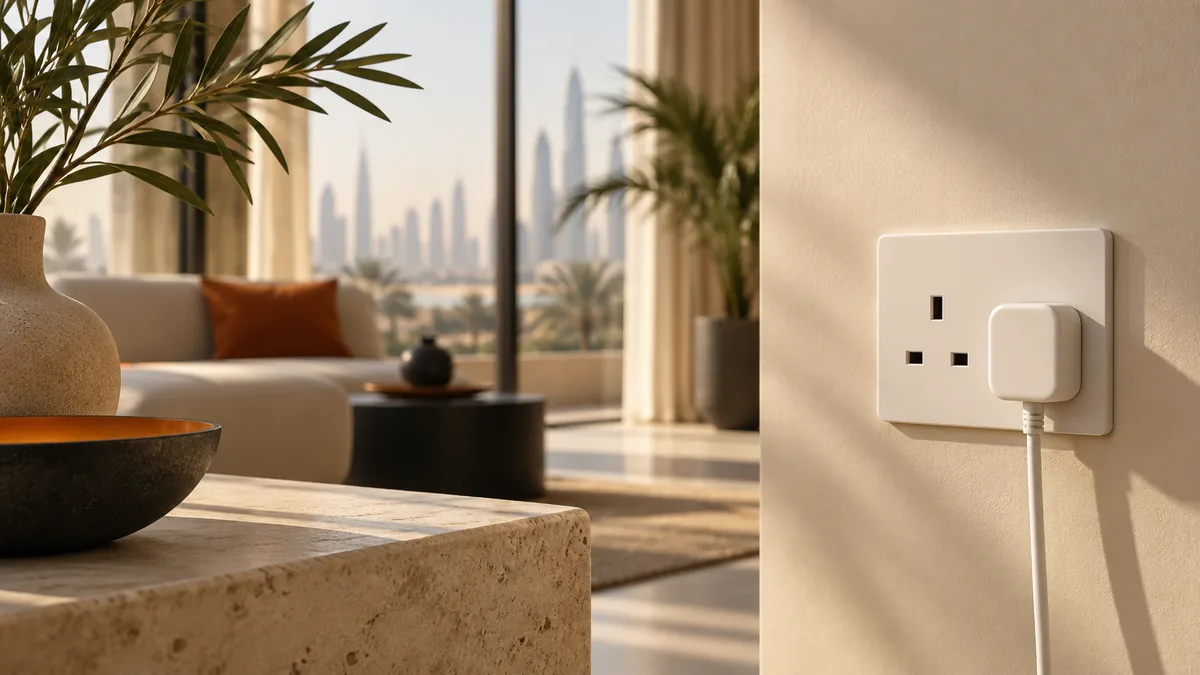
Best Smart Plugs Under AED 120 only helps if the plug, the app, and the power standard match a UAE home. Anything with a plug needs a 220–240V rating and a Type G (three-pin) connection. A travel adapter does not make a 110V appliance safe to use. Links from the UAE open the Amazon.ae listing when the visitor is in the UAE. That is not a promise the model is in stock — open the listing and confirm delivery to your emirate before you count on it. The notes below compare TP-Link Kasa Smart Plug Mini and Amazon Smart Plug from manuals and widely published owner reports, not from a private lab.
modest smart plugs to automate your home.
Smart plugs are the easiest way to start automating your home.
Quick Comparison
| — | TP-Link Kasa Smart Plug Mini | Amazon Smart Plug |
|---|---|---|
| Best for | Compact | Perfect for Alexa |
| Standout | Compact | Perfect for Alexa |
| Trade-off | No energy monitoring | No Google Home support |
Quick Answer: Which Smart Plug to Buy
The TP-Link Kasa Smart Plug Mini is our pick for most people shopping under AED 120. It works with both Alexa and Google Home, so it doesn't lock you into one voice assistant, and its compact shape doesn't block the second outlet on a standard duplex wall socket the way bulkier plugs do.
The Amazon Smart Plug is the pick if you've already built your home around Alexa and Echo devices. It's just as simple to set up, just as compact, and in an all-Amazon household the integration is a little more seamless — routines, groups, and voice naming all live in the same app you're already using for everything else. The trade-off is real: it has no Google Home support at all, so it's a non-starter the moment a Google speaker enters the house.
If you're not sure which voice assistant you'll end up standardizing on, or you already have devices from both ecosystems, the Kasa Mini is the safer buy — it covers both cases and the Amazon plug covers only one.
What Actually Matters in a Sub-higher-tier Smart Plug
In this tier, the feature that separates a good smart plug from an annoying one isn't a spec sheet item — it's whether it reconnects to Wi-Fi reliably after a power outage or router reboot. modest plugs that need to be manually re-paired after every blip become the outlet everyone in the house stops trusting.
Beyond reliability, the two things worth checking are voice assistant compatibility and physical size. Compatibility determines whether the plug fits into a smart home you already have or forces you to add a new app just for one outlet. Size matters more than it sounds: a plug with a wide body can cover the second socket on a two-outlet wall plate, effectively costing you an outlet you already paid for. Energy monitoring, scheduling flexibility, and geofencing are nice extras, but neither of these two plugs offers energy monitoring, and neither loses points for it — that feature usually adds cost without changing how most people actually use a plug day to day.
Kasa Mini vs. Amazon Smart Plug: Where They Actually Differ
On paper these two plugs look nearly identical: both are compact, both skip the hub requirement, both handle basic on/off scheduling and remote control from a phone. The real difference shows up in the app and ecosystem, not the hardware. The Kasa app supports both Alexa and Google Assistant voice commands and groups nicely with other TP-Link Kasa gear if you expand later. The Amazon Smart Plug skips its own dedicated app entirely for day-to-day use in most households — it's designed to be set up and then controlled almost entirely through the Alexa app or by voice.
That design choice is exactly why the Amazon plug feels so simple for Alexa households and so limiting for anyone else. There's no Google Home path at all, so it's not a matter of a slightly worse experience — it simply won't appear as a device Google Assistant can control. Neither plug supports Apple HomeKit, so iPhone users relying on the Home app should look elsewhere regardless of which of these two they'd otherwise prefer.
Neither device includes energy monitoring, and physically the two are close enough in size that outlet-blocking isn't a deciding factor between them — the deciding factor is entirely which voice assistant, or assistants, you actually use.
Setup and Everyday Reliability
Both plugs follow the same basic setup pattern: plug it in, open the corresponding app, connect it to your home Wi-Fi network, and name it something you'll actually remember when giving voice commands. Neither requires a separate hub, which keeps the cost and the shelf space down compared to smart home systems built around Zigbee or Z-Wave bridges — a real advantage for anyone just testing whether home automation is worth the effort.
Day to day, the tasks people actually use a -ish smart plug for are narrow: turning lamps on and off on a schedule, killing power to a space heater or fan remotely, or triggering a routine like "turn off all downstairs plugs" before bed.
How this was researched
These notes come from published specifications, manuals, and patterns that show up repeatedly in owner reports. TechGadgetSpot did not run a private lab session for this guide. Use the specs against how you will actually use the item in the UAE: heat, dust, Type G power where a plug is involved, app availability, and whether Amazon.ae can deliver it.
Final Verdict
The TP-Link Kasa Mini is the best all-rounder, while the Amazon Smart Plug is ideal for Alexa users.
The picks
TP-Link Kasa Smart Plug Mini
Compact, works with Alexa and Google Home, no hub needed.
Pros
- Compact
- Easy setup
- Reliable
Cons
- No energy monitoring
Amazon Smart Plug
Works seamlessly with Alexa, simple and reliable.
Pros
- Perfect for Alexa
- Simple
- Compact
Cons
- No Google Home support
Prefer devices that still do their basic job if a cloud service is withdrawn, and confirm the app is available in the UAE. A White Friday or Ramadan listing is worth a look, but only after the voltage and the plug are right.
Frequently asked questions
Do smart plugs work without a hub?
Both plugs in this guide connect directly to your home Wi-Fi network and don't require a separate smart home hub — you set them up entirely through their companion app on your phone. This keeps upfront cost and setup complexity lower than hub-based systems like Zigbee or Z-Wave, though it also means each plug talks to your router individually rather than through a dedicated smart home radio, which is worth knowing if you eventually scale up to a dozen or more devices.
Can I use a smart plug with a space heater or other high-wattage appliance?
Check the plug's rated wattage or amperage before using it with anything that draws significant power, like a space heater or window air conditioner — smart plugs in this tier tier are typically rated for standard household loads, not high-draw appliances. For low-power devices like lamps, fans, chargers, and holiday lights, either plug in this guide is a safe and reliable fit.
Which smart plug should I buy if I use both Alexa and Google Home?
The TP-Link Kasa Smart Plug Mini, without much debate. It's built to support both Alexa and Google Assistant voice commands, so it works no matter which speaker you happen to be near. The Amazon Smart Plug has no Google Home support at all, so it only makes sense in a household that has fully standardized on Alexa.
Do these smart plugs track energy usage?
No — neither the TP-Link Kasa Smart Plug Mini nor the Amazon Smart Plug includes energy monitoring. If tracking how much power a specific device draws over time matters to you, you'll need to look at a plug specifically marketed with energy monitoring, which typically costs more and adds a data screen to the app. For simple remote on/off control and scheduling, that extra feature isn't necessary.
Keep reading
Guide
Smart Home Guides
Smart plugs, bulbs, security cameras, thermostats, and streaming devices — compared on reliability and everyday fit.
Smart home
Philips Hue vs Wyze Bulbs: Which Smart Lights Are Better?
Philips Hue and Wyze are the two biggest names in smart bulbs, but they target very different budgets. We compare their color quality, ecosystem, and trade-offs.
Smart home
Best Smart Bulbs Under AED 200
Bright, color-changing smart bulbs for ordinary rooms.
Smart home
Echo vs Echo Dot: Which One is Right for You?
Amazon's Echo and Echo Dot are both great smart speakers, but they serve different needs. Here's which one earns its spot in your home.
As an Amazon Associate, TechGadgetSpot earns from qualifying purchases.